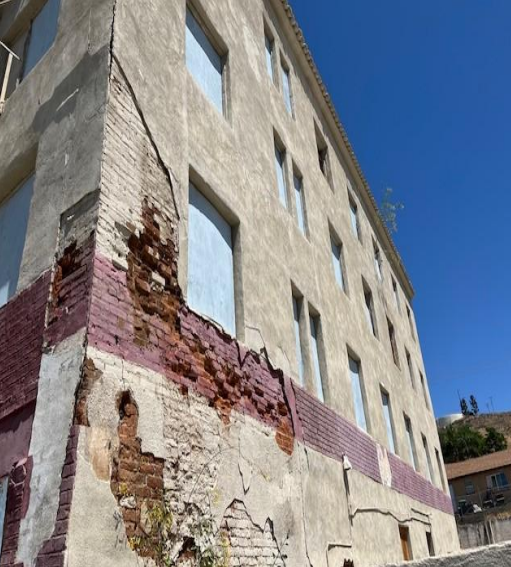
LAKE ELSINORE — The Lake Elsinore City Council unanimously approved a $198,000 demolition contract Tuesday for the former Ambassador Hotel, even as a state appeals court order prevents the city from proceeding with demolition. At the same time, the building’s nonprofit owner challenges a lower court’s nuisance-abatement order.
The council voted Aug. 11 to award the public works agreement to Precision Works Inc. for demolition of the building at 164 S. Main St. The council also authorized the city manager to approve potential change orders of up to $19,800, or 10% of the contract price.
The vote does not mean demolition can immediately proceed.
The California Court of Appeal issued a temporary stay Aug. 7 after the Dream Center of Lake Elsinore appealed a Riverside County Superior Court order directing the city to abate conditions at the property through demolition. The city has said it stopped work after receiving the appellate court’s order.
City Attorney Barbara Leibold told the council Tuesday that the city would comply with the stay.
“The city is not taking any additional action,” Leibold said. “We will comply with the Court of Appeal.”
The dispute is the latest development in a yearslong disagreement over the future of the former hotel, which the Dream Center acquired with plans to restore and repurpose it.
The city maintains that its actions are based on building safety and code compliance, not opposition to the Dream Center or its charitable work. The Dream Center contends it has been working toward restoration and says changing city requirements impeded its ability to move the project forward.
Superior Court ordered demolition
The legal situation changed significantly July 21, when Riverside County Superior Court issued an abatement order finding the building to be a public nuisance and directing the city to immediately abate the nuisance through demolition, according to the city.
The city says 65 substandard, illegal or dangerous conditions have been identified at the property and that the building has been red-tagged as unsafe to occupy.
According to the city, code enforcement problems preceded the Dream Center’s ownership. The city initially filed a lawsuit against the former owner seeking correction of the violations.
Before acquiring the property, the Dream Center entered into a compliance agreement acknowledging the violations and agreeing to deadlines for correcting them, according to the city. The organization also agreed to become a party to the existing litigation and acknowledged that the city could seek relief from the court if compliance was not achieved.
The city says it subsequently delayed enforcement efforts for years while allowing the Dream Center an opportunity to address the problems.
Leibold told the council Tuesday that the city eventually concluded the violations had not been corrected.
“After five years of working with the Dream Center, there’s been no remediation,” Leibold said. “The property has continued to decline. So, with no remediation and the building left to continue to decline, the city did seek court relief.”
The Dream Center disputes the city’s characterization of its efforts.
Executive Director Brett Masters has said the organization maintained the property and worked through the city’s requirements while pursuing its rehabilitation plans. He said the organization believed it had made progress toward meeting those requirements before encountering additional permitting requirements in 2024 that it says effectively stopped the restoration effort.
The Dream Center has described the building as an important piece of Lake Elsinore history and says its goal is to restore and repurpose the property as a residential discipleship center.
Its website currently seeks public support for “Restoration & Repurposing of the Ambassador Hotel.”
City prepared for demolition before court ruling
The city’s demolition bidding process began before the Superior Court issued its July 21 order.
According to the city’s staff report, the city published its notice inviting bids June 22 and conducted a mandatory site visit July 1. Ten bids were received by the July 16 deadline.
The council’s Aug. 11 action awarded the contract to Precision Works.
After receiving the Superior Court’s July 21 order, the city began taking preliminary steps toward demolition, including securing permits for asbestos removal.
Leibold told the council that asbestos abatement began Aug. 6 and continued Aug. 7. She said that work was separate from the demolition contract considered by the council Tuesday.
The Court of Appeal issued its temporary stay Aug. 7.
Leibold said limited work may still be necessary to secure asbestos-containing materials that had already been disturbed. She said workers would need to cover and seal roof tiles so they would not blow away and potentially release asbestos.
Beyond those protective measures, the demolition is on hold while the appellate court considers the matter.
Dream Center says it intended restoration
The Dream Center’s position is that demolition would eliminate a historic property it has been attempting to rehabilitate for community use.
Masters has said the organization envisioned converting the building into a residential program providing services and support to people seeking to rebuild their lives.
The Dream Center is a Lake Elsinore nonprofit that provides food assistance, neighborhood programs and other services. Its activities extend beyond the Ambassador Hotel property and are not the subject of the city’s abatement action.
The dispute therefore centers on the condition and future of the Ambassador property, rather than whether the Dream Center may continue operating its other programs.
The city also has acknowledged the organization’s work in the community.
“The City recognizes the work performed by the Dream Center and other organizations that serve residents in need,” the city said in a statement released Tuesday, while maintaining that property owners must comply with health and safety laws.
The city said it remains willing to work with the Dream Center and community organizations to find locations where services can continue safely.
Different accounts of what went wrong
A central issue in the dispute is whether the Dream Center was given a reasonable opportunity to rehabilitate the property and whether meaningful progress was made.
The city says nearly five years passed without correction of the conditions identified in the compliance agreement and that the building continued to deteriorate.
The Dream Center says it diligently pursued the city’s requirements and contends the process changed after it had completed initial steps toward rehabilitation.
Those competing claims are now intertwined with the litigation.
The Superior Court’s July 21 ruling favored the city’s position sufficiently to authorize nuisance abatement and demolition. The Dream Center’s appeal, however, means the legal dispute is not finished. The appellate court’s temporary stay does not itself resolve the merits of the Dream Center’s challenge; it prevents demolition while the appellate proceedings continue.
Building has long history downtown
The property has a lengthy history in downtown Lake Elsinore.
The site dates to the city’s early development. According to historical information compiled by the Dream Center, a two-story brick building was constructed there in 1887 by Lake Elsinore founder Franklin Heald. It housed Consolidated Bank and community meeting space, and the organization says early City Council meetings were held there.
The property was later converted for hotel use and eventually became known as the Ambassador Hotel.
The existing building has been substantially altered over the decades, complicating questions about its historical significance and potential preservation.
The building has also been vacant for decades.
The Dream Center acquired the property with the stated intention of rehabilitating it rather than demolishing it. Its current Ambassador Project materials continue to solicit support for preservation and reuse.
The city, however, maintains that the present enforcement action concerns the physical condition of the existing structure rather than future use of the property.
If demolition ultimately occurs, the Dream Center would continue to own the property and could seek approval for another lawful development there, according to the city.
For now, Tuesday’s council vote puts a demolition contractor in place but does not authorize the city to disregard the appellate court’s stay.
The future of the Ambassador Hotel will depend in large part on what happens next in the Dream Center’s appeal.