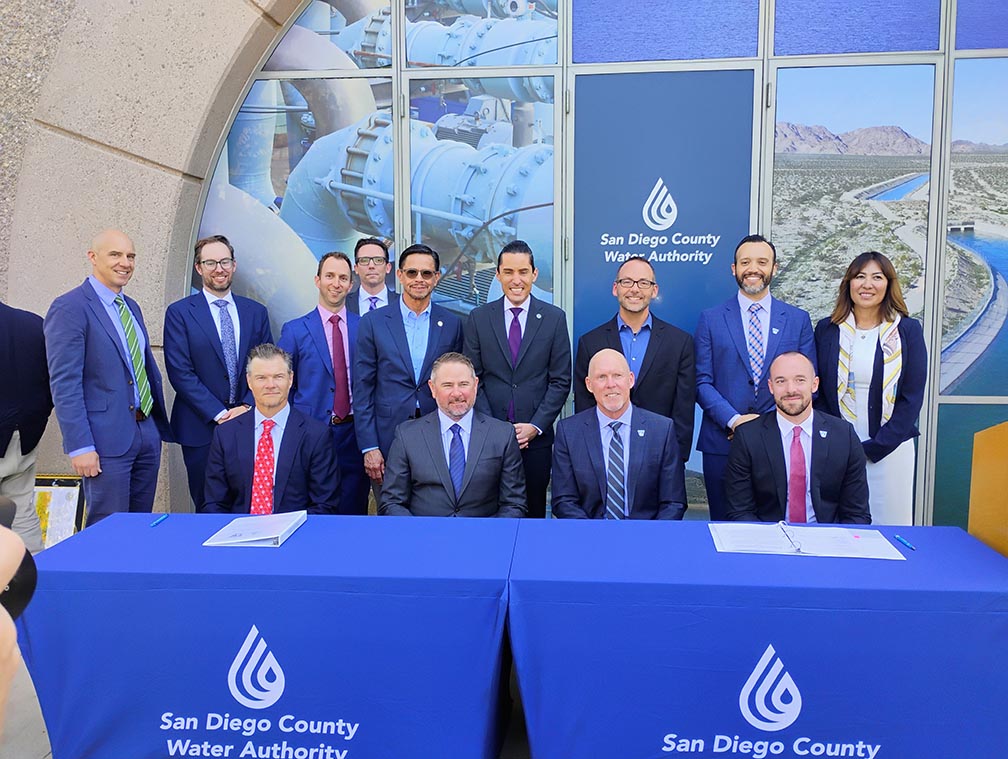
A water transfer agreement involving the Western Municipal Water District, the San Diego County Water Authority, and the Metropolitan Water District of Southern California was signed March 19 in San Diego.
The signing followed a unanimous SDCWA board vote to approve the agreement. Western Water will purchase a minimum of 10,000 acre-feet of water annually from the CWA.
“This is a very important aspect of Western Water’s future. It’s a very important agreement for Southern California, and we’re proud to be a partner,” said Western Water general manager Craig Miller.
“We’re proud of this historic agreement, and we’re grateful for the opportunity to move forward together,” said Western board president Laura Roughton.
Western and the CWA are both members of the Metropolitan Water District of Southern California. Both receive wholesale water from MWD while both also have sources of local supply.
MWD obtains water from the Colorado River Aqueduct which transports water from Parker to Lake Mathews and from the State Water Project which brings water from Oroville to Lake Skinner. “MWD water comes from many sources,” said CWA general manager Dan Denham.
MWD and the CWA began delivering water to San Diego County in 1947. MWD’s San Diego Aqueduct conveys water to a delivery point six miles south of the Riverside County line. That allowed MWD and the CWA to provide equal contributions to connect from MWD’s Colorado River Aqueduct to the San Vicente Reservoir in Lakeside.
Prior to the 1991 drought approximately 95 percent of the CWA supply was purchased from MWD. The CWA has since worked to diversify its supply. Only 40 percent of the 2018 supply was from MWD.
In 2003 the CWA approved the Quantification Settlement Agreement which brings conserved water from the Imperial Irrigation District to San Diego County and also involved lining the Coachella Canal and the All-American Canal. The agreement with IID is for 75 years and the agreement to obtain water from the lining of the canals is for 110 years. QSA supplies now account for approximately half of the CWA demands. Conserved water transfer provides 200,000 acre-feet annually for the San Diego region through water conservation measures in the Imperial Valley. It is the largest agriculture to urban water transfer in the nation. The agreement also includes a “wheeling” fee to transport water through MWD’s aqueducts.
Construction on the Claude “Bud” Lewis Carlsbad Desalination Plant and a ten-mile pipeline began in 2013. The plant began delivery of desalinated water in December 2015. The CWA annually obtains between 48,000 and 56,000 acre-feet from the desalination facility.
“We’ve been at the cutting edge of water supply innovation for many years,” Dehnam said.
The California Water Code requires all urban water suppliers in the state to prepare and submit an Urban Water Management Plan which must include a detailed evaluation of the supplies necessary to meet expected demand over at least a 20-year period in both normal years and dry years. The plan must be updated every five years. An urban water supplier is defined as an agency which provides water for municipal purposes to more than 3,000 customers or provides more than 3,000 acre-feet of non-agricultural water annually.
The CWA’s most recent Urban Water Management Plan was approved by the board in May 2021 and forecasts 555,578 acre-feet of supply in 2025, 578,244 acre-feet for 2030, 598,474 acre-feet in 2035, and 614,235 acre-feet for 2040. The expected 2045 demand is 630,771 acre-feet with desalination and the QSA accounting for 328,000 acre-feet, purchases from MWD providing 49,193 acre-feet, and local supply from CWA member agencies totaling 252,875 acre-feet.
The population growth within the CWA area which increased during the late 20th century has stabilized. The CWA and its member agencies have promoted conservation practices. Due to conservation along with increased efficiency, the per capita demand has decreased by approximately 50 percent since the early 1990s.
Under the agreement approved March 19 the transfer of water from the CWA to Western won’t involve physical transport between the two agencies but rather the MWD aqueduct system delivering water allocated for the CWA to Western turnouts.
“This partnership allows us to take advantage of reliable water which is already available,” Roughton said.
“It marks the first sale of water from one Metropolitan agency to another using our existing system,” said MWD board president Adan Ortega.
“It was conserved by the residents and businesses of San Diego,” Ortega said. “Conservation and efficiency results in real water that is stored in reservoirs, and this is a way of spreading the benefits.”
The transfer agreement thus will not require any additional facilities. “We all know how expensive it is to build infrastructure,” Miller said.
“It’s a tribute to the businesses and the residents who have done so much to conserve water,” Ortega said.
The Western Municipal Water District has a service area of 527 square miles and is a wholesale agency as well as a retail agency. In addition to providing water directly to retail accounts, Western also uses its MWD membership to provide imported water to the Elsinore Valley Municipal Water District, the Rancho California Water District, the Temescal Valley Water District, the cities of Corona, Norco, and Riverside, the Jurupa Community Services District, and the Eagle Valley and Box Springs mutual water companies. Western serves customers directly in Eagle Valley, El Sobrante, Lake Mathews, Mission Grove, Orangecrest, Temescal Canyon, and Woodcrest and portions of Mead Valley and Perris. Western also provides water to March Air Reserve Base. For wholesale and retail combined the district provides water to approximately one million people, and Western has approximately 25,000 meter connections. Western distributes approximately 25 billion gallons annually with approximately 60 percent of that being imported and 40 percent obtained from local supply.
“My job is to make sure that a million people have enough water 24/7,” Miller said. “That job is getting harder.”
During Calendar Year 2026 the CWA is charging its member agencies $1,490 per acre-foot for untreated water, and there are also pro-rata shares of CWA fixed charges. Western will receive at least 10,000 acre-feet of water over the next 21 years and will also pre-purchase approximately 30,000 acre-feet for future delivery. Western will purchase the water for $1,350 per acre-foot (the MWD rates for CWA purchases include wheeling charges which will not occur when the water is delivered directly to Western). The agreement will provide $13.5 million annually for the CWA, and including the up-front payments the CWA will obtain approximately $100 million of revenue over the next five years.
“It’s going to benefit ratepayers across the county,” Denham said.
The annual transfer amount is enough to supply approximately 30,000 Western Water households. “For us it develops a baseline of water to diversify our portfolio,” Miller said.
“It strengthens reliability for Western,” said CWA board chair Nick Serrano, who is one of the City of San Diego delegates to the CWA board.
“No good agreement is one-sided,” Miller said. “It provides benefits to all of Southern California’s water users.”
“It’s much more than just a contract,” Serrano said. “This is a long-term regional supply agreement.”
Western, the CWA, and MWD began discussions on the transfer in late September. “We’ve been actively working with them since October,” Denham said.
The negotiations focused on aligning CWA priorities with partner priorities, creative solutions for short-term and long-term challenges, and quantity and term matters. “It was not without challenges,” Denham said.
The CWA’s priorities are long-term resilience and durability, supply and demand rebalancing, and ratepayer impacts. “Our colleagues in this room have done a great deal of work,” Denham said.
“This is the result of long-term planning,” Roughton said.
“It’s the culmination of a great deal of work,” Serrano said. “It is a first of a kind partnership.”
“It was touching to see the culmination of that work,” Roughton said.
“Everything centers on the people that we serve, and this agreement truly reflects that,” Roughton said. “This kind of collaboration is going to become more important as we move ahead.”
The sale of CWA water to Western is actually beneficial for CWA ratepayers, since the additional revenue helps cover some of the CWA’s fixed costs. “It builds flexibility and provides us with flexibility,” Denham said. “It maximizes our existing assets.”
Western may request additional supply, and the CWA will provide that if the water is available. Western also has the ability to increase the contract quantity amount.
“This is groundbreaking for them as much as it is for us,” Denham said.
“We’re ready to move to a new era in water management,” Miller said.
“This is a model for collaboration,” Miller said. “This hopefully sets a new stage and a new model for water planning.”
“It’s a wonderful way to do business. We’re stronger for that,” Roughton said.
“We do this for our customers,” Roughton said. “It’s all for them.”
“We are known for being on the cutting edge, and obviously this is on the cutting edge,” said CWA board vice-chair Frank Hilliker, who is the Lakeside Water District representative on the CWA board.
“Agreements like this show that we are not standing still. We are moving forward with purpose,” Serrano said. “Sometimes never done before is not a barrier. Sometimes it’s an opportunity.”
“Our future is cooperation. It’s collaboration,” Miller said.
“This is a proud moment for Southern California,” Denham said. “We hope that this is the first of many efforts to develop partnerships.”
The agreement formally ends on December 31, 2047, but it is automatically extended unless Western opts not to continue after that date. Those terms match the Quantification Settlement Agreement in which the initial term of the CWA-IID conserved water transfer agreement runs through 2047 while if both parties agree the QSA can be renewed through 2077.
“Western’s intention is that this agreement lasts until 2077,” Miller said.
Joe Naiman can be reached at jnaiman@reedermedia.com.