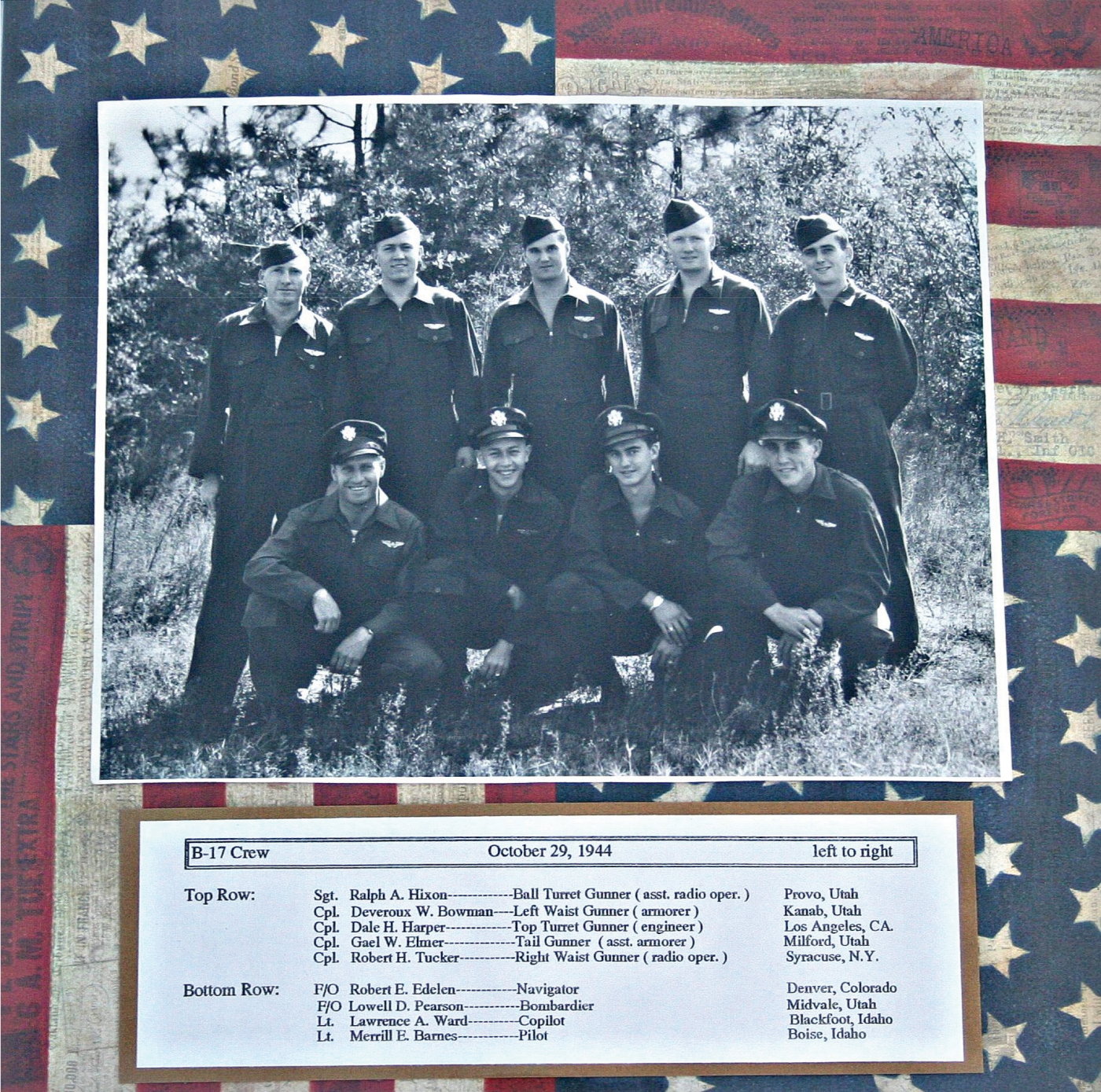
Longtime local George Ward shared the story of his father 2nd Lt. Lawrence Alfred Ward, whose B-17 bomber was struck by German anti-aircraft fire during WWII. He was a young American pilot who parachuted into enemy territory, endured months as a prisoner of war and lived to tell a remarkable story of courage, sacrifice and survival.
On the morning of Feb. 13, 1945, 20-year-old 2nd Lt. Lawrence Alfred Ward climbed aboard a B-17 Flying Fortress at an American air base in Italy, unaware that the mission ahead would change his life forever.
It was his sixth combat mission of World War II. His crew had been assigned to bomb the Vienna South Ordnance Depot in Austria, a heavily defended target deep inside enemy territory.
Before the day was over, their aircraft would be destroyed, two crewmen would be dead, and Ward would find himself hanging from a parachute in the bitter winter air above Hungary, about to begin a harrowing journey through Nazi Germany as a prisoner of war.
Nearly 50 years later, Ward would write a detailed account of that day and the months that followed, preserving a remarkable firsthand record of survival, suffering and the extraordinary resilience of American servicemen.
He titled his memoir Our Fateful Sixth Mission.
A young man goes to war
Born April 25, 1924, in Blackfoot, Idaho, Ward graduated from high school in 1942 and enlisted in the U.S. Army Air Forces during World War II.
He became a second lieutenant and co-pilot of a B-17 Flying Fortress assigned to the 32nd Bomb Squadron, 301st Bomb Group, 15th Air Force, operating from Italy.
The B-17, one of the most recognizable American bombers of the war, was designed to withstand extraordinary punishment. Its crews flew dangerous missions over enemy territory, often facing German fighter aircraft and intense antiaircraft fire.
Ward’s aircraft, serial number 44-6546, had a crew of 10 men. Its pilot was 1st Lt. Merrill E. Barnes, a fellow Idaho native from Boise.
The crew had already flown successful missions, including attacks on targets in Austria. But their sixth mission had been postponed three times because of poor weather.
On Feb. 13, the weather finally cleared enough for the bombers to take off.
Ward remembered having an uneasy feeling that morning.
After the mission briefing, he lingered to speak with the briefing officer. He could not explain why he felt something was wrong, but the feeling was strong enough that he double-checked his flying equipment.
He discovered that his parachute was beyond its inspection date and obtained a replacement.
That seemingly minor decision would soon save his life.
The aircraft was still waiting when Ward finally arrived.
The crew had developed a fondness for their bomber and had planned to name it after a loved one. But they never had the opportunity.
The sky explodes over Austria
The bombers climbed toward 30,000 feet, where the air was so cold that crews relied on oxygen masks and electrically heated flying suits to survive.
Ward remembered temperatures between 30 and 32 degrees below zero.
Their aircraft took its position on the left wing of another bomber as the formation crossed the mountains toward Austria.
For much of the journey, the skies appeared relatively quiet.
Then, as they approached their target, German anti-aircraft guns opened fire.
Ward recalled that the flak was so heavy it seemed possible to walk on it.
Just minutes before reaching the target, the aircraft directly ahead of them appeared to explode. Ward watched as his own bomber flew through the debris.
Despite the danger, the crew continued toward the target and successfully released its bombs.
But their ordeal was only beginning.
As the aircraft turned away, Ward felt violent explosions beneath the bomber.
Looking down, he could see flashes from a German anti-aircraft battery on the ground.
The aircraft’s engineer, Staff Sgt. Dale Harper, reported that a shell had torn through the fuselage and exited through the top without exploding.
The crew had been extraordinarily fortunate.
Their luck did not last.
Ward noticed that the aircraft’s controls seemed to be striking something whenever he attempted a left turn. Barnes checked the controls, and the two men briefly believed they could continue flying.
Then a waist gunner reported smoke coming from the left wing.
The wing was on fire.
The crew prepared to abandon the aircraft and initially considered heading toward Russian-held territory.
Suddenly, the left wing buckled.
The bomber plunged into a spin.
Barnes shouted for the crew to bail out.
Ward tried to leave his seat, but the tremendous centrifugal force pinned him in place.
He struggled to free himself as the aircraft spiraled toward the earth.
Finally, he managed to get out of his seat and reach the escape hatch.
The navigator and engineer were struggling near the opening.
One crewman went out, followed by another.
Ward jumped after them.
Moments later, he was falling through the clouds.
A parachute, a forest, and German soldiers
Ward’s parachute opened successfully.
As he descended, he tried to locate the other members of his crew.
Below him, he spotted two parachutes that had become tangled together. They belonged to navigator Robert Edelen and engineer Dale Harper.
He watched helplessly as their parachutes fell away from sight.
Then he looked toward the ground and realized he was drifting into a forest.
He attempted to maneuver away from the trees but could not.
His parachute caught in the branches of a large tree, abruptly stopping his fall.
Ward was left suspended high above the ground.
German soldiers soon arrived.
They brought a ladder to help him down, but when one soldier produced a large knife to cut him free, Ward became alarmed.
Despite the danger and the injuries he had suffered during his landing, he managed to climb onto a large branch.
He demanded that the soldiers return his pistol and told them in German that he would climb down himself.
The Germans were Luftwaffe guards stationed near the western shore of Lake Balaton in Hungary.
Ward and the other surviving airmen were captured.
That night, the prisoners were held in German barracks.
The guards attempted to feed them blood sausage, apparently recognizing that the captured Americans were hungry.
For Ward, the war had entered a frightening new chapter.
The long journey into captivity
The next day, Feb. 14, Ward and his fellow prisoners were loaded onto a truck with another captured B-24 bomber crew.
They began a three-day journey toward Bratislava, in present-day Slovakia, for interrogation.
Along the way, they passed through Vienna.
From their vehicle, Ward could see the destruction caused by Allied bombing raids, including damage to the very railroad and industrial facilities American aircrews had been sent to attack.
At one stop, the prisoners were placed in the basement of a house with a dirt floor, a broken window and little protection from the winter cold.
They discovered a small stove and attempted to warm themselves.
A local boy noticed their predicament and brought them carrots.
Ward remembered appreciating the simple act of kindness.
During the journey, the Germans also brought in a captured Russian pilot who was badly injured and had received no medical care.
Ward and several fellow prisoners who spoke other languages attempted to communicate with him and the guards.
The suffering of the Russian airman left an impression.
At Bratislava, Ward was interrogated by German authorities.
He was still injured from his parachute landing. The impact against the tree had left him badly bruised, and he could barely walk.
The German interrogator became frustrated when Ward refused to provide information.
The officer broke Ward’s nose.
He then searched Ward’s possessions, discovering a small kit containing personal items, including a gold signet ring given to Ward by his fiancée.
When the interrogator examined the ring, Ward turned it toward his palm and explained that it was his wedding ring.
The German allowed him to keep it.
It was a small victory in an increasingly desperate situation.
Prisoners caught between two armies
As Allied forces advanced into Germany, Ward and the other prisoners were repeatedly moved from place to place.
They traveled in trucks, railroad cars and on foot, often with little food, inadequate clothing and almost no protection from the winter weather.
During one movement through Vienna, civilians confronted the prisoners.
Women screamed at them, spat on them and threw rocks.
Signs on damaged buildings blamed Americans for the destruction.
Ward understood that the prisoners were surrounded by people whose homes and cities had been devastated by the same bombing campaign in which he had participated.
At another stop, the prisoners learned that some of their guards were Polish men who had been forced into German service through threats against their families.
One guard spoke Polish with an American prisoner, giving the men a glimpse of the complicated and brutal circumstances of the war.
The prisoners eventually traveled in crowded cattle cars toward Germany.
During one nighttime journey, an Allied bombing raid struck nearby railroad facilities.
A bomb exploded close enough to tear a hole in a German guard’s duffel bag.
Then British bombers began dropping enormous bombs nearby.
The prisoners could hear the explosions and the terrifying sound of falling shrapnel.
The train was trapped in the middle of the attack.
Ward remembered the deafening noise and the helplessness of being locked inside a railroad car while bombs fell around them.
Remarkably, the prisoners survived without injury.
Hunger, cold and the struggle to survive
At Frankfurt, Ward was placed in solitary confinement for approximately four days.
His cell contained a cot, a blanket and a broken window.
The cold was severe.
He received little more than a slice of bread and a bowl of watery soup each day.
Later, the prisoners were transported toward Nuremberg, where they were housed in barracks near other Allied prisoners.
Food remained scarce.
Ward recalled receiving a small portion of sauerkraut, sawdust bread and occasionally a bowl of watery soup containing a horse leg bone.
By the time he was freed, he had lost 35 pounds.
Yet even under those conditions, Ward found ways to occupy himself and maintain a sense of purpose.
He discovered a piece of metal outside the prison fence and carefully worked it into his possession.
Using concrete blocks, he shaped it into a blade, carved a handle and fashioned a homemade knife.
He made a sheath from cloth and cardboard and concealed the knife from the guards.
It was a small act of independence in a place where prisoners controlled almost nothing about their lives.
There were moments of compassion as well.
Red Cross packages occasionally reached the prisoners, providing desperately needed food.
Representatives of the Salvation Army also brought supplies.
Ward remembered their generosity.
Bombs fall on the prisoners
One of Ward’s most frightening experiences occurred in early March 1945.
The prisoners were aboard a train near Crailsheim, Germany, when it stopped beside a railroad yard.
Guards allowed them to get off briefly for water.
Suddenly, the prisoners heard aircraft approaching.
They watched as American bombers appeared overhead.
The aircraft began releasing their bombs directly toward the railroad facilities.
Ward and the other prisoners were standing near the intended target.
They could see the bombs falling.
Moments later, explosions erupted around the railroad yard.
Freight cars were thrown into the air.
German antiaircraft guns opened fire, and fighters appeared.
Ward remembered the scene as one of extraordinary destruction.
The prisoners scrambled for cover as the attack continued for more than an hour.
The guards and prisoners alike were terrified.
Yet when the bombing ended, Ward and his companions had survived.
Once again, the young American airman had escaped death.
The final days of the war
By April 1945, Germany was collapsing.
The prisoners were moved again, this time toward Moosburg, where thousands of Allied servicemen were being held.
Ward’s leg remained painful from his injuries, so he was transported by train while other prisoners were forced to walk.
During the journey, he watched American fighter aircraft attack German positions near Nuremberg.
One pilot appeared to recognize the prisoners and waggled his wings.
The men watched as other fighters did the same.
For Ward, the sight of American aircraft brought hope that the end of captivity might be near.
At Moosburg, he was placed in a prisoner-of-war camp surrounded by barbed wire.
Ward wrote that he was told more than 50,000 American, British and Russian prisoners were being held there.
Around April 22, while standing outside enjoying the sunshine, he heard a familiar voice.
Turning around, he discovered a friend from high school.
The two young men had graduated in 1942 and gone to war separately.
One had flown with the Eighth Air Force from England. Ward had flown with the 15th Air Force from Italy.
Now, after surviving combat and capture, they had unexpectedly reunited in a German prison camp.
It was an extraordinary coincidence in the closing days of the war.
Freedom at last
On April 29, 1945, American forces under Gen. George S. Patton reached Moosburg and liberated the prisoners.
The following day, Ward entered the camp headquarters and found the records the Germans had maintained on him.
He marked his file with a single word:
“Liberated.”
After months of captivity, the young airman was free.
On May 1, Ward enjoyed a slice of white bread.
It was a simple pleasure, but after months of hunger and poor prison rations, he remembered how good it tasted.
In the days that followed, the former prisoners were transported through Germany and France.
On May 8, 1945, the day Germany’s surrender brought the war in Europe to an end, Ward was flown to Reims, France.
He wrote three words in his memoir:
“WAR IS OVER!”
Later that month, while being processed for his return home, Ward saw Gen. Dwight D. Eisenhower.
On June 2, he boarded the Liberty ship Sea Porpoise.
Two days later, he departed Southampton, England, bound for New York and home.
The long ordeal that began over Austria nearly four months earlier was finally ending.
Remembering those who never came home
Not every member of Ward’s crew survived the destruction of their bomber.
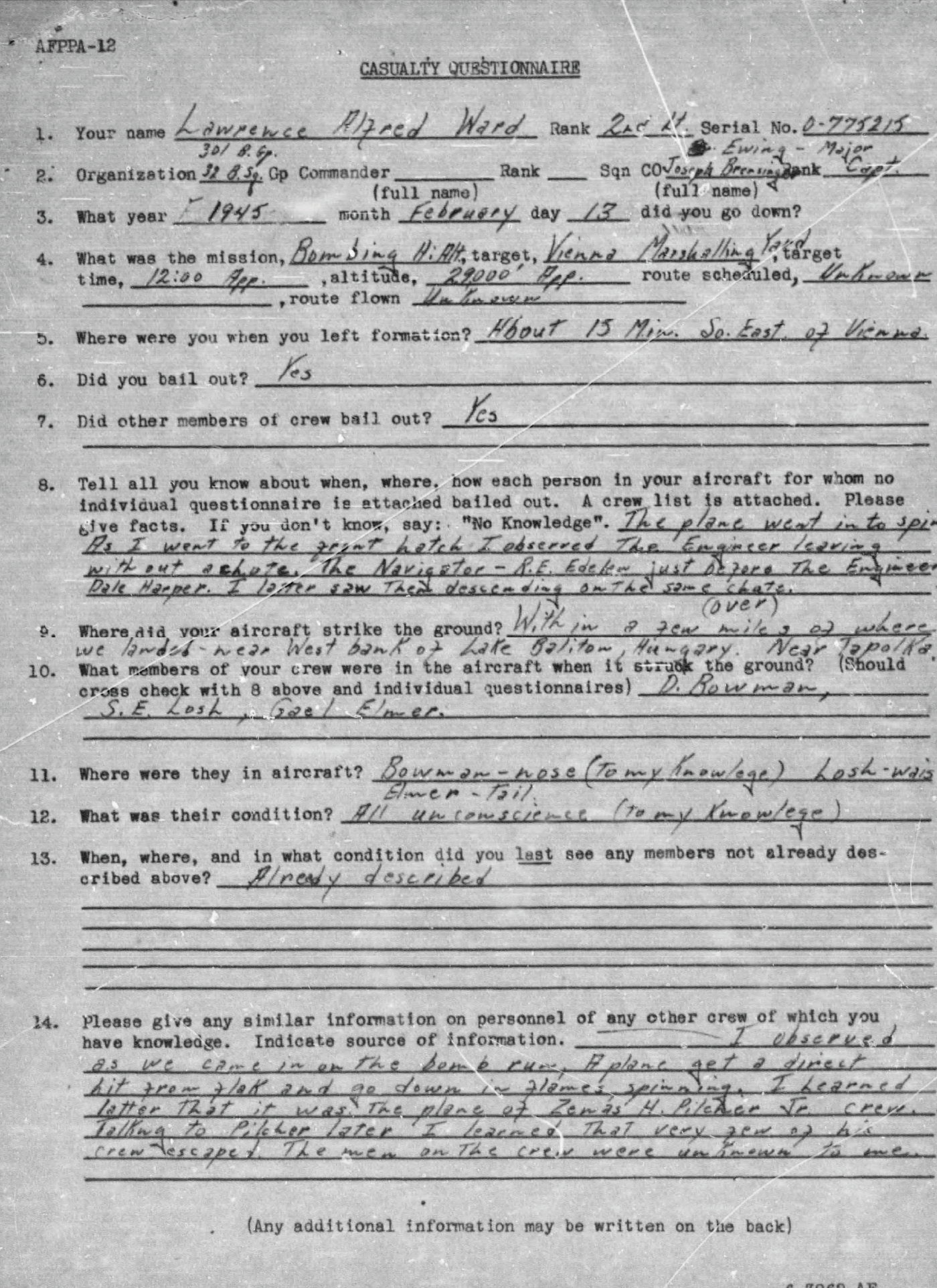
Staff Sgt. Sanford Losh, a waist gunner, was killed in the crash.
Staff Sgt. Devereux Bowman, another crewman, also died.
Others survived but suffered injuries during their escape from the aircraft and subsequent captivity.
Ward’s postwar casualty questionnaire preserved important details about their final moments aboard the bomber.
He described the desperate efforts of crewmen trying to escape the damaged aircraft and the injuries suffered by those who parachuted to safety.
The documents are a reminder that the story of a surviving veteran is also the story of the men who flew beside him.
For every airman who returned home, there were others whose lives ended far from their families, in the skies over Europe or on the ground below.
A lifetime of service
Ward’s military service did not end with World War II.
He returned to active duty and served during both the Korean War and the Vietnam War, ultimately retiring from the U.S. Air Force with the rank of major.
His decorations included the Air Medal, Purple Heart and Prisoner of War Medal.
In July 1994, nearly half a century after his B-17 was shot down, Ward committed his wartime experiences to paper.
His memoir did not dwell on grand statements about heroism.
Instead, he described the ordinary details of extraordinary circumstances: a replacement parachute, a ring from his fiancée, a boy offering carrots, a slice of white bread, a familiar voice behind a prison fence.
Those details bring the experiences of a generation of American servicemen into focus.
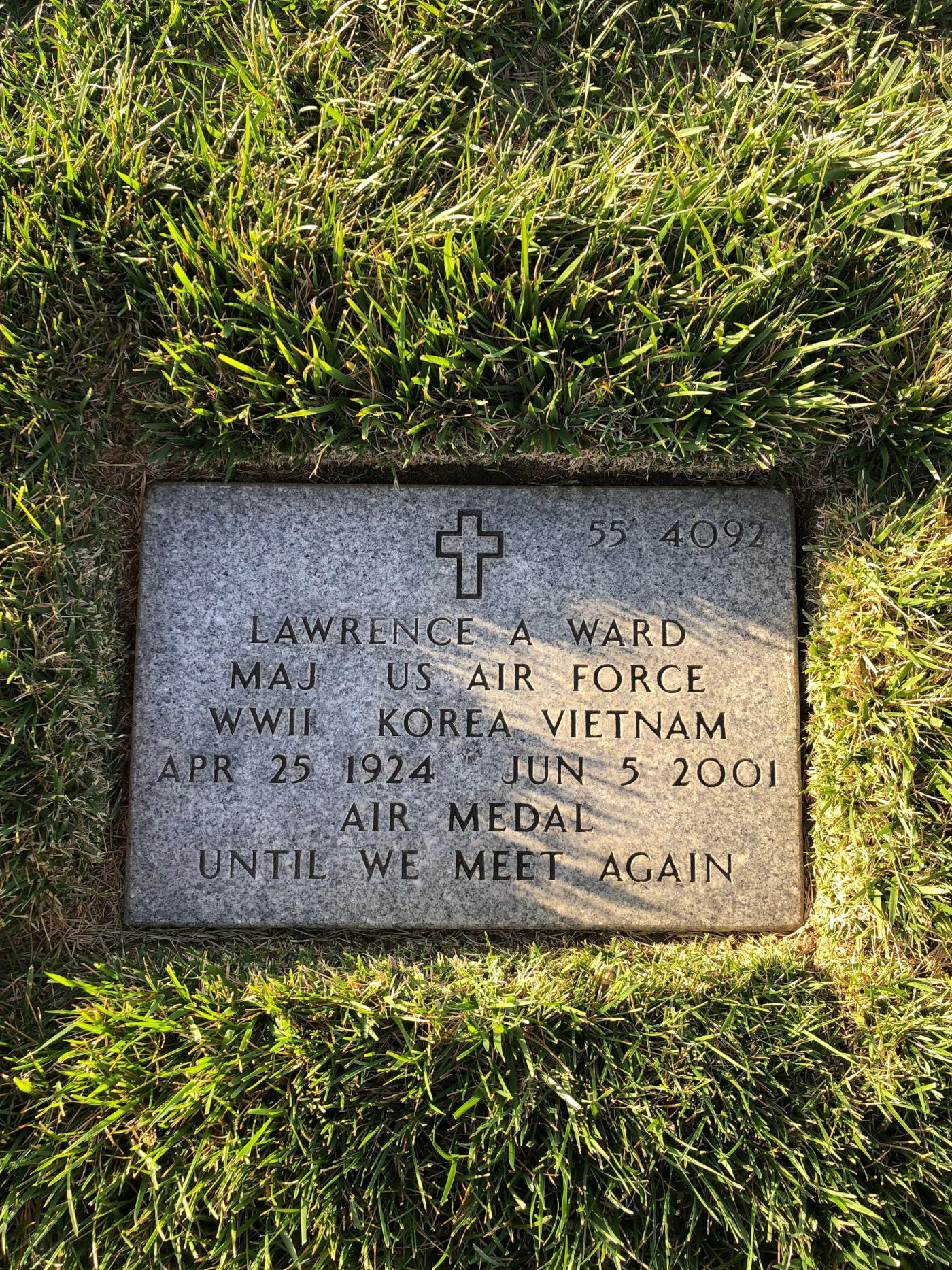
Lawrence Alfred Ward died June 5, 2001, at age 77.
He is buried at Riverside National Cemetery, where his grave marker records his service in World War II, Korea and Vietnam.
The marker also bears the words “Until We Meet Again.”
His life spanned three wars, but his written account of that fateful sixth mission preserves the experiences of a young man who faced death in the skies over Austria, endured captivity in Nazi Germany and lived to return home.
More than eight decades after that B-17 fell from the sky, Ward’s story remains a powerful reminder of the sacrifices made by those who served — and of the importance of preserving their memories for generations who will never know war as they did.
His aircraft was lost.
Two of his fellow crewmen never returned.
But Lawrence Ward survived to tell their story.
And because he did, their courage has not been forgotten.