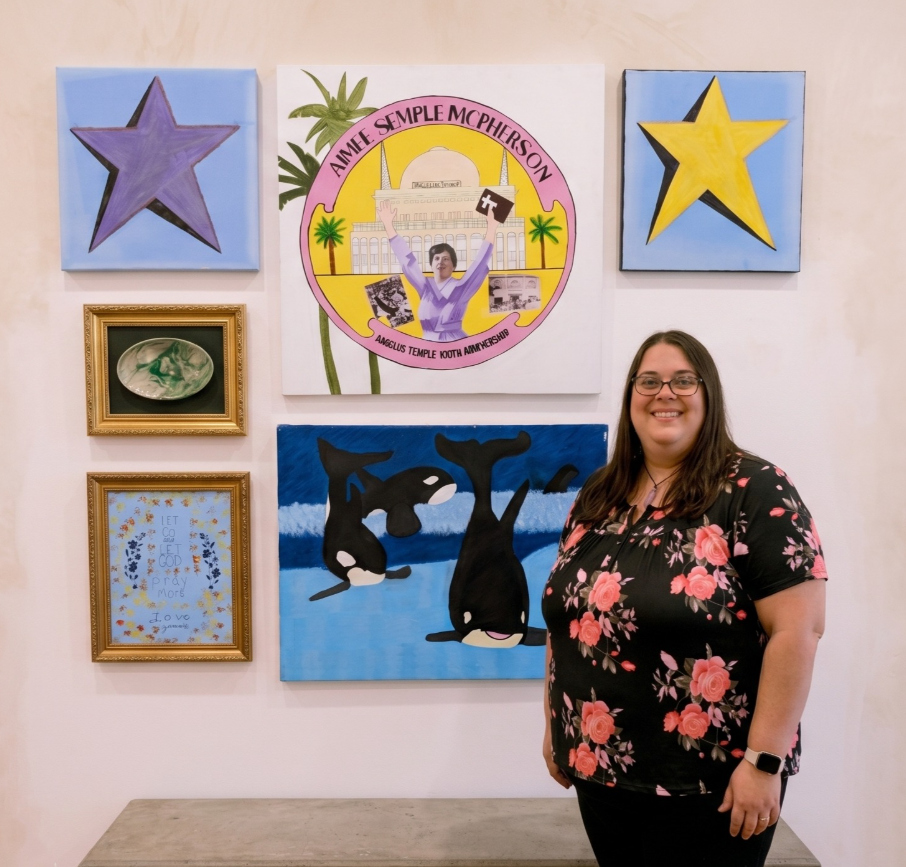


Gabby Ledesma does not want to be defined by a diagnosis. She would rather talk about color, texture and the next piece of art she plans to create.
An artist who works in acrylics, mosaics, resin, mixed media and digital art, Ledesma has spent years taking college art classes and developing her own style. She especially enjoys painting sunflowers, rainbows and sunsets, and hopes to display and sell more of her work in galleries, museums, businesses and other public spaces.
“I’m just a very creative person,” Ledesma said. For her, making art means being able “to be creative, to know what my colors were and how to make a pretty picture.”
Her growing body of work is also part of a larger story. Gabby has mosaic Down syndrome, the rarest of the three primary forms of Down syndrome. It accounts for about 2% of people diagnosed with the condition.
Most people have 46 chromosomes in each cell. Down syndrome occurs when a person has an extra full or partial copy of chromosome 21. In the most common form, trisomy 21, the extra chromosome is present in all cells examined. In mosaic Down syndrome, some cells have the usual 46 chromosomes while others have 47, including the additional chromosome 21.
That mixture can produce wide differences from one person to another. Some people with mosaic Down syndrome have fewer or less pronounced physical and developmental characteristics, but that is not true in every case. The percentage of affected cells found in a blood sample also cannot reliably predict a person’s abilities because the proportion may differ in other tissues throughout the body.
Possible characteristics include low muscle tone, developmental or learning differences and delays in speech or language. As with other forms of Down syndrome, some people may also experience congenital heart conditions; hearing or vision difficulties; or thyroid, gastrointestinal and other health concerns. Regular, appropriate medical screening remains important even when outward features are subtle.
For Ledesma, the signs were not immediately clear. Her mother said the pregnancy had seemed normal, and Gabby was a sweet, happy baby. At a two-week appointment, however, the pediatrician noticed her almond-shaped eyes and the way her tongue sometimes rested outside her mouth and said Down syndrome was possible.
Gabby did not have all the physical traits often associated with the condition, and the family did not receive a firm diagnosis at that time. As she grew, her mother noticed that she reached some milestones more slowly than other children. She was less physically active as an infant, gained weight more slowly and was late sitting and crawling, although she walked at about 13 or 14 months.
Vision was one of her early challenges. Doctors at Children’s Hospital Los Angeles diagnosed a weak eye muscle, commonly called lazy eye. Her family chose glasses rather than surgery while she was still a baby.
Speech developed more slowly as well. As Ledesma approached age 3, she spoke only a limited number of words, and the hospital recommended speech therapy. She remembers having particular difficulty pronouncing her S and R sounds.
“I can say everything just right,” she said of the progress she made through speech therapy and years of practice.
Genetic testing later confirmed that Gabby had mosaic Down syndrome. A chromosome analysis, or karyotype, is commonly used to diagnose the condition. Because mosaicism can vary by tissue, doctors sometimes examine additional cells or another type of tissue when signs remain but a blood test is unclear.
Her school years brought both encouragement and painful moments. Her mother recalled one teacher suggesting, while she was still in elementary school, that she had reached the limit of what she could learn. The family rejected that conclusion and searched for a more supportive educational setting.
The change made a difference. Gabby flourished in a program where she received greater support, met more students and worked with educators who recognized her potential. Her experience reflects an important reality of mosaic Down syndrome: a diagnosis or laboratory percentage cannot determine the course of a person’s life.
As an adult, Gabby continued her education. She attended community college while living in Santa Maria and later took classes at MiraCosta College, where she studied art for years. Her coursework has included acrylic painting, ceramics, sculpture and digital art. She said some academic classes have been difficult and that the right assistance can be hard to find, but she continues to pursue opportunities to learn.
That persistence is visible in her art. Gabby works with brushes, sponges and whatever tools help her create the effect she wants. In mixed-media pieces, she combines painted backgrounds with photographs and other elements. She has also created resin art and mosaics using small tiles arranged into colorful designs.
Some of her most meaningful work explores her family history. Gabby is a descendant of evangelist Aimee Semple McPherson and has created artwork and display boards honoring that connection. She would like to see those pieces exhibited in museums, along with other work that tells her family’s story.
Her immediate goals are practical: prepare her canvases for display, find local venues willing to show them and continue building a portfolio. She hopes each exhibit will lead to another opportunity and help more people discover her work.
Her story is not one of a condition disappearing. It is a story of living fully with a condition that can look different in every person. Her early delays were real, as were the assumptions others made about her. So were the speech therapy, supportive teachers, family advocacy, college courses and years of patient work that helped her develop her abilities.
Now, when Gabby Ledesma looks ahead, she sees more art to make and more places to share it. Mosaic Down syndrome is part of her life, but it is only one part of the picture.