Conflicting descriptions and questions about decades-old DNA evidence warrant investigation, but the woman’s extraordinary claim remains unverified
This is the first part of a series of stories relating to this investigation.
More than four decades after 3-year-old Laura Ann Bradbury disappeared from a Joshua Tree campground, a woman living near Twentynine Palms has come forward with an extraordinary claim: She believes she is Laura. AC Investigations is working with the woman to help find the answers she is looking for, including reuniting the family, if in fact, she is who she believes she is.
The woman, who asks to be called Laura, says she remembers walking into a blue van after a man told her he was Santa Claus. She says she was subsequently raised under another name by people who repeatedly hinted that she was not their biological child.
She also points to physical similarities between herself and childhood photographs of Laura, including what she describes as matching scars and freckles. She says memories from her childhood correspond with details of the 1984 disappearance, including a man and a blue van.
There is an uncanny resemblance with her photo placed next to a picture of Patty Bradbury, the mother, who is now deceased.
The woman’s claim has not been verified by law enforcement. When she kept hitting roadblocks, she hired a private investigator, Anthony Campbell, from AC Investigations who works with the Valley News group of newspapers. Campbell specializes in finding missing people and has taken this woman on as a client.
Authorities announced in 1990 that DNA testing established, with greater than 99% probability, that skull fragments discovered near the campground came from a child of Laura’s parents. Additional testing discussed publicly in 2010 was also described as providing strong evidence that the remains were Laura’s.
Those findings present a substantial scientific obstacle to the woman’s claim, but she insists that they aren’t accurate and she is Laura Ann Bradbury.
At the same time, decades of sometimes contradictory public accounts — including conflicting descriptions of Laura’s eye and hair color and questions raised by her father about the remains — have persuaded Campbell and this newspaper that the woman’s information should be evaluated rather than summarily dismissed.
The issue will be resolved through properly documented DNA comparisons in the next two weeks.
The background is that a little girl, Laura, was 3½ when she disappeared Oct. 18, 1984, from Indian Cove Campground, then part of Joshua Tree National Monument. The area later became part of Joshua Tree National Park.
Laura had accompanied her 8-year-old brother, Travis, to a campground restroom. According to published accounts, Travis went inside while Laura waited outside. When he emerged, she was gone.
More than 250 searchers, assisted by helicopters, horses and tracking dogs, combed the rugged desert. The official search was discontinued after three days, but Laura’s parents, Michael and Patty Bradbury, continued looking for her for years.
Witnesses reported seeing a stocky, bearded man near a metallic-blue Ford Econoline van in the campground. Investigators later said footprints believed to be Laura’s led toward the location where the van had been parked. No witness reported seeing someone physically take her. There were reports that the footprints were later dismissed.
The San Bernardino County Sheriff’s Department continues to publish an open cold-case bulletin describing Laura as a victim and asking anyone with information to contact homicide investigators.
Laura became one of the most recognizable missing children of the 1980s. Her photograph appeared on milk cartons, and her family distributed millions of fliers and T-shirts. Her disappearance was reenacted on national television, and the Bradburys established a center to receive tips and promote awareness of missing children.
During an interview with Valley News and Campbell, the woman said she remembers arriving at the campground with her biological family in 1984.
“I remember that my brother had to go to the bathroom before we ever got to Joshua Tree National Monument,” she said.
She said she remembers a man inside a van speaking to her.
“He said, ‘Hey, I’m Santa Claus. My hair turns white at Christmastime,’” she recalled. “And I climbed into his van by myself. They didn’t pick me up. They didn’t take me. I climbed into the van.”
Her assertion that the vehicle was blue is consistent with the type and color of the van sought by investigators after Laura’s disappearance. The detail is not secret, however, and has appeared in news reports, case summaries and television programs for decades.
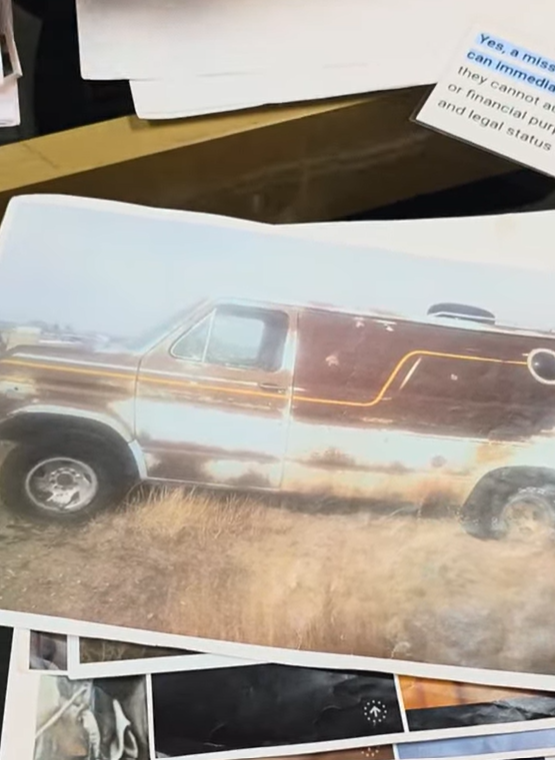
The fact that her “family” still has a Ford Econoline van, as described in 1984 as a van that was being sought is interesting. The van is now rusting in a field out of state. This woman, who believes she is Laura, has pictures of the old rusted van.
The woman said after she was taken, she did not immediately understand that she would not be returned to her family. She alleges that she was frightened and mistreated by the people who raised her, but not sexually abused. She said that as she grew older, a man in the household sometimes shouted that she was not his child while a woman told him not to say that.
She recalls that when she was taken by two men, the father and son in the van, she was taken to a house and the woman was yelling, “Take it back, take it back!”
She also recalled later being in a vehicle that was stopped by a California Highway Patrol officer while one of the children held a sign in a rear window saying, “Help a kidnapped kid”. She says she remembers that the mother driving the car specifically said, “You’re going to get me in trouble, rather than you are going to get in trouble.” Our interviewee claims she later contacted the CHP and was told a record of the stop existed.
This newspaper has not obtained that record or independently confirmed the conversation with the CHP.
The woman said the adults who raised her gave her a different name and birth date. She possesses a birth certificate under that identity but contends that the document contains inconsistencies. She has not obtained Laura Bradbury’s birth certificate or other original Bradbury family records for comparison.
She further alleges that another boy appeared in the household when she was young and was later presented as her twin. Her description of repeated eighth birthdays and shifting identities is among the details requiring substantial independent documentation.
There are some discrepancies that can’t be easily dismissed. The woman’s blue eyes initially appeared to conflict with a 1984 missing-child poster describing Laura as having brown hair and brown eyes.
A 1990 Los Angeles Times report also referred to Laura’s brown eyes.
Other materials, however, describe Laura as having blond hair and blue eyes. The milk carton from the period also appears to list blue eyes.
Because reproductions of old photographs can distort hair and eye color — and because information was sometimes copied incorrectly among early missing-child publications — those discrepancies neither prove nor disprove the woman’s claim.
The inconsistencies do mean that eye color should not be treated as the deciding factor.
Campbell initially questioned the woman’s account partly because of the brown-eye description. However, “There were just so many facts that lined up, I couldn’t stop thinking about it.” After talking to a local pastor who has law enforcement connections and had also been working with this woman, I couldn’t give up. Then we located the 1980s materials listing blue eyes, so we concluded that the discrepancy was less definitive than it first appeared.”
“The biggest factor for me was the strong facial resemblance between the woman and photographs of Patty Bradbury, Laura’s mother. It became imperative that the DNA testing was done somehow.
The woman says she has scars and freckles in locations that appear to correspond with marks visible in photographs of Laura.
Then there is a disputed history of the remains. In March 1986, hikers found a skullcap and other bone fragments in rugged terrain near Indian Cove, less than three miles from the Bradbury campsite.
San Bernardino County Coroner Irving Root initially said the remains appeared to be from a child between 2 and 5 years old and had likely been in the area for no more than two years, according to a March 1986 Los Angeles Times report.
Early efforts to identify the remains did not provide a definitive answer.
In January 1989, the Sheriff’s Department announced that an initial form of genetic fingerprinting found the fragments genetically consistent with Laura. Officials emphasized at the time that the results were not conclusive and commissioned another analysis, according to contemporaneous reporting.
In December 1990, the department announced that newer testing provided proof “beyond a reasonable scientific certainty” that the remains were Laura’s. Officials said the testing showed a greater than 99% probability that the remains belonged to a child of Michael and Patty Bradbury, the Los Angeles Times reported.
Investigators stopped pursuing reported sightings of Laura as a living child, although the investigation into how she died remained open.
The history became more complicated again years later.
Michael Bradbury publicly questioned whether the remains he was later shown were the same skullcap he and his wife had seen following the 1986 discovery. He also cited a report that he believed contained inconsistent test results, including a reported failure to match genetic material from the fragments with hair saved from Laura’s hairbrush.
In 2010, more advanced testing reportedly found “strong evidence” that the remains were the child of Michael and Patty Bradbury. The test was described as confirming the skull’s identification as Laura’s, according to an extensive Los Angeles Times account.
Michael Bradbury said at the time that he accepted the result, although he continued questioning how the remains reached a location previously searched by hundreds of people.
The available reporting therefore does not support a claim that the remains were simply ruled “inconclusive.” Rather, the record shows early inconclusive or disputed testing followed by at least two rounds of testing that authorities considered strong enough to identify the remains as Laura’s.
There is much more to this investigation and story. This is the first in a series of stories relating to the disappearance of Laura Bradbury and a woman who is convinced she is the missing girl. This series is also highlighting what journalists and private investigators processes are and how much time and investigation goes into a story, or a potential story.
Both the Bradbury family and “Laura” have agreed to a legal DNA test with Chain of Custody documentation that will take place in the next two weeks. Video of interviews and more information is available at MyValleyNews.com.