Justin and Crystal Vanderwal use agricultural drones to help growers treat crops more precisely, reach difficult terrain and reduce reliance on ground equipment.
Through Driftline Precision, Justin and Crystal Vanderwal are introducing farmers, vineyard operators, orchard owners and other agricultural producers to large spraying drones capable of applying fertilizer, fungicides, pesticides and other crop treatments with remarkable precision.
Justin Vanderwal’s interest in the technology began while he was working in environmental geoscience. He used drones to map areas around the Santa Margarita River and participated in an experiment involving a full-spectrum camera.
“We were starting to experiment with a full-spectrum camera to see if we could measure the chlorophyll in the water without having to go measure everything by hand,” he said.
The experience changed the direction of his career. “That was the bug that got into me, and I haven’t stopped flying since,” Vanderwal said.
He later worked with agricultural drones at Kendall Farms, a Fallbrook-area flower grower with fields spread across hundreds of acres of the region’s rolling terrain. Kendall Farms had established its own drone program and needed someone to operate it.
Vanderwal, who stands 7 feet tall, jokes that his height eliminated one possible aviation career.
“I’m too big to be a real pilot, so drone pilot is the next best thing,” he said.
Vanderwal began flying drones in 2014 and obtained his commercial drone license in 2016, when the Federal Aviation Administration’s Part 107 regulations took effect. He has flown professionally since 2020, but his experience with agricultural spraying drones began a little more than two years ago. Once he saw what the machines could do, he recognized a larger opportunity.
“I went over there and learned how to do it and thought, ‘There’s a real market here,’” he said. “I could help a lot of farmers and get it done quicker.”
Agricultural spraying traditionally has been performed by workers on foot, tractor-mounted equipment, helicopters or fixed-wing agricultural aircraft. Vanderwal said drones are not intended to replace every one of those methods. Instead, they offer growers another tool that can serve large-acreage operations as well as smaller fields, irregularly shaped parcels and steep or muddy terrain.
“Helicopters and air tractors are fantastic,” he said. “They can cover huge acreages very fast.”
Large aircraft, however, are not necessarily the most practical choice for a quarter-acre field, a narrow growing area or a hillside bordered by buildings, roads or other obstacles. At the same time, the production capacity of newer agricultural drones allows them to work efficiently across large, open farming operations.
“It’s just a different tool in the toolbox,” Vanderwal said.
A drone can be programmed with the precise boundaries of a field and directed to fly a designated route at a selected speed, elevation and application rate. Once the route is established, the aircraft follows it consistently.
“You tell it exactly where you want it to be and at what rate you want to apply, and it will execute it,” he said.
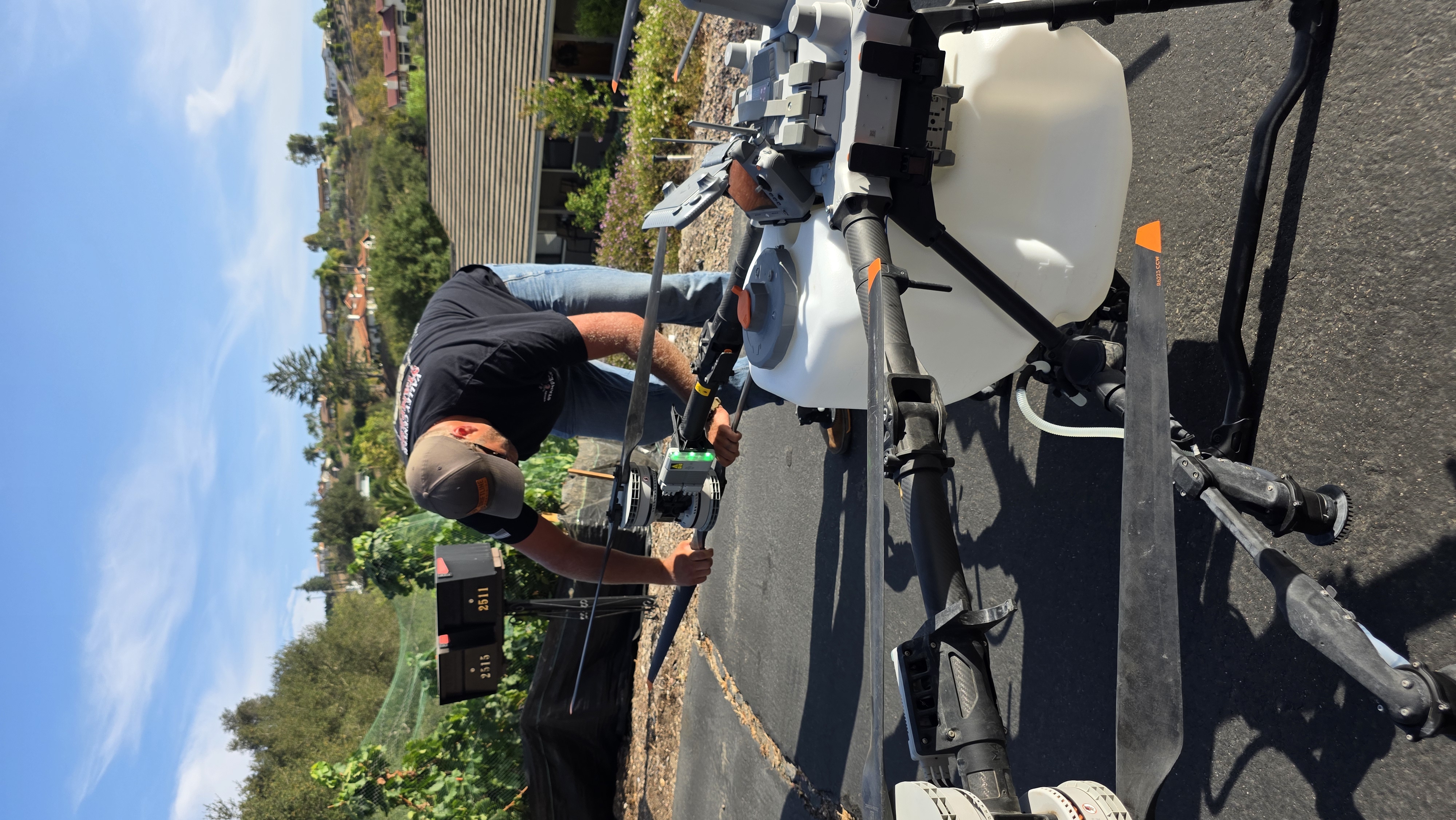
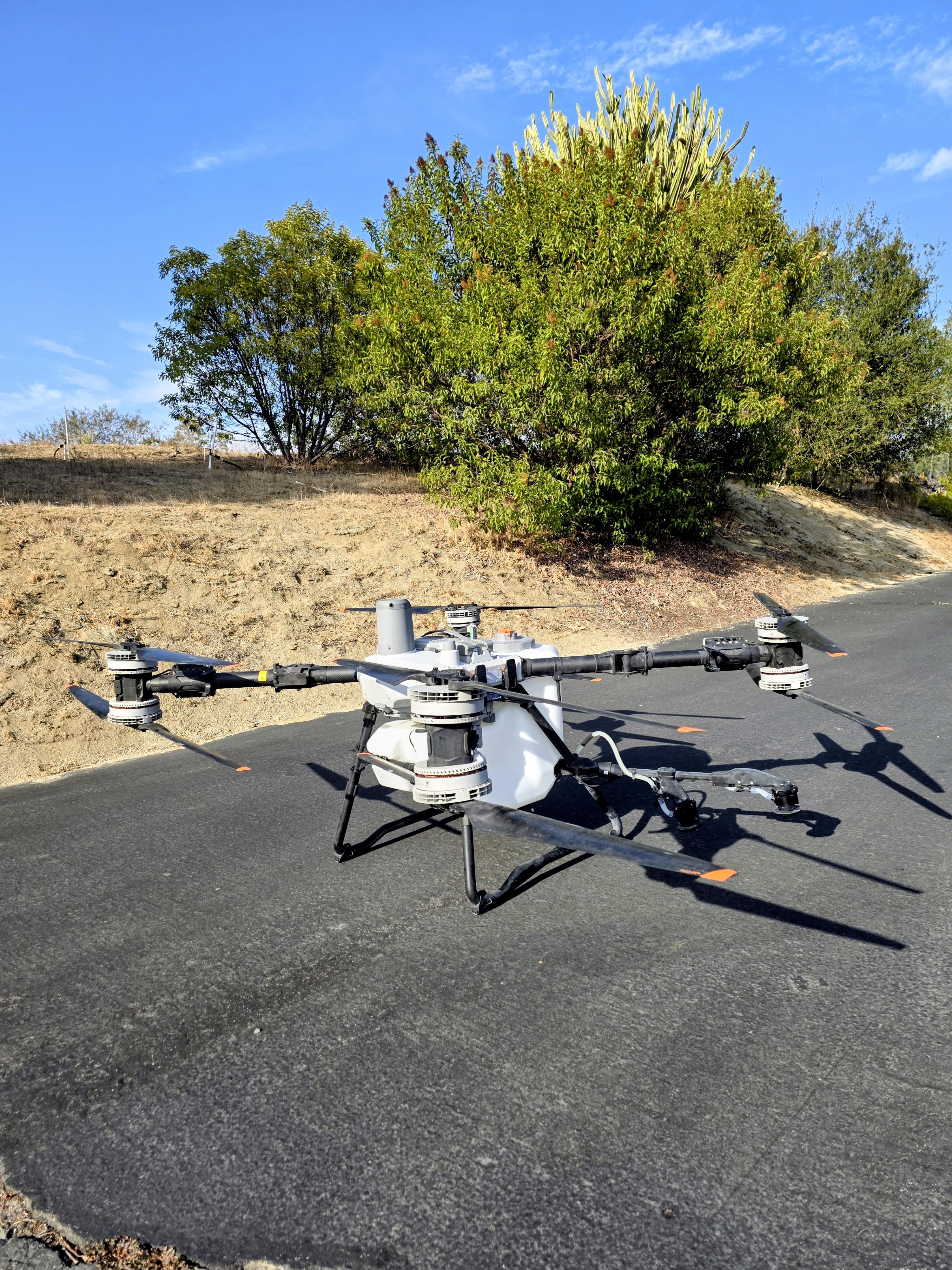
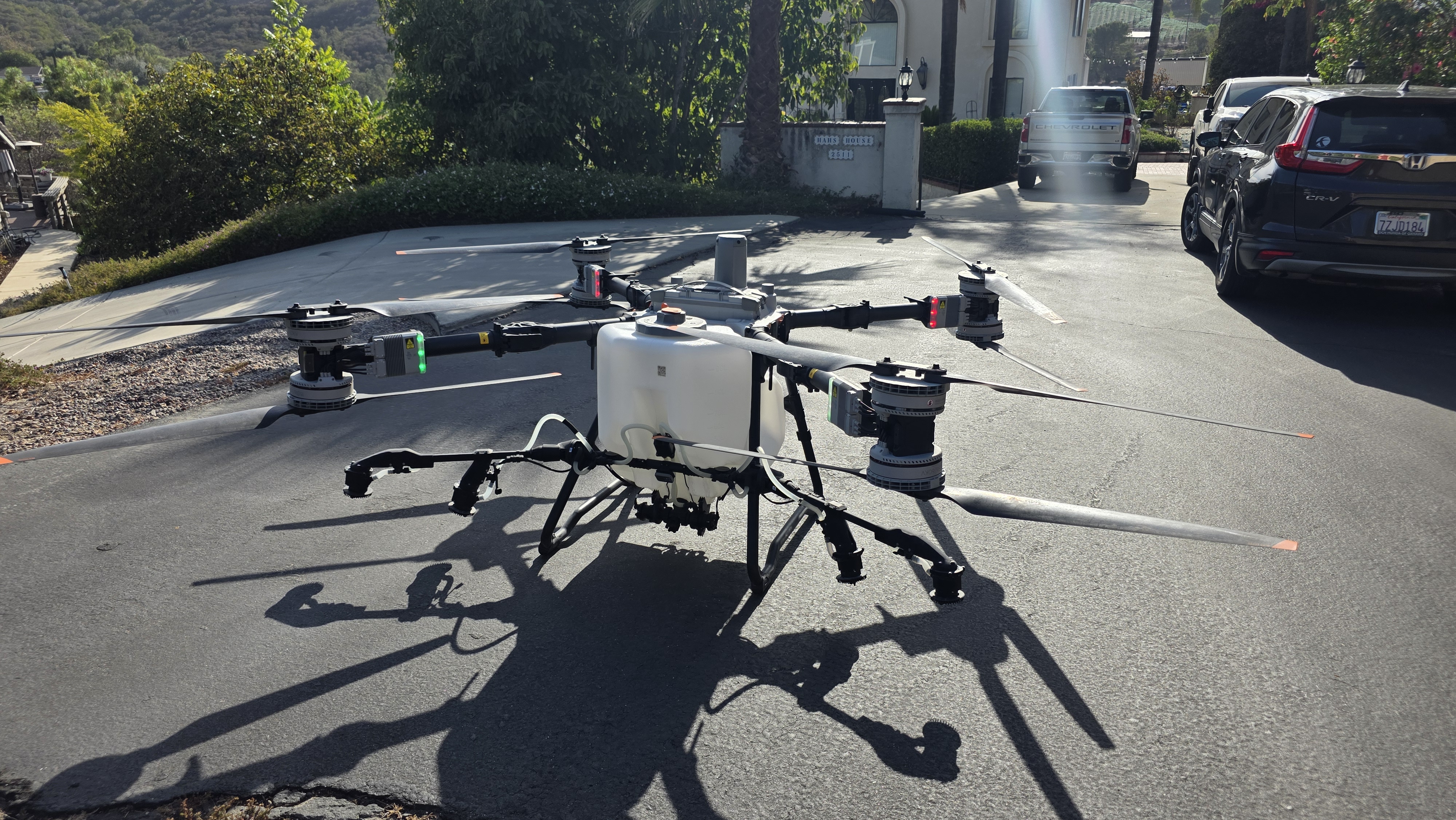
The Vanderwals’ drones are approximately 13 feet wide when their arms and propellers are extended. On a wide-open field, Justin said, a drone can travel about 50 mph while working.
The amount of land that can be treated in an hour depends on the volume of material applied per acre. At an application rate of 2 gallons per acre, Justin said, the equipment can comfortably cover about 90 acres in an hour of flight time. Higher-volume treatments require additional time for refilling and application.
The drones can also perform what is known as a prescription or variable-rate application. Instead of treating an entire field at the same rate, the operator can load a treatment map directing the drone to apply a lighter treatment in one area and a heavier treatment in another.
“If only the middle section has a real problem, you can go light in one area, lay it down heavier in the middle and then go back to light,” Justin said. “You don’t have to change anything while it is flying. It will take care of it.”
The treatment map and application recommendations are provided to Driftline Precision. The company serves as the applicator and does not independently diagnose crop conditions or decide where pesticide application rates should be increased or decreased.
The variable-rate capability can help farmers avoid applying more product than is needed across an entire field.
The rugged topography around Temecula, Fallbrook, and Southern California presents a recurring challenge for agricultural operations. Groves, vineyards, and flower fields have been planted along hillsides that can be difficult for tractors and crews to reach.
Drones can fly over the terrain without placing workers or heavy machinery on steep slopes.
“Our local topography is not flat, and we’ve planted all the hills everywhere,” Justin said. “You can’t exactly get ground crews everywhere, but you can fly over them.”
Wet weather can make that advantage even more significant. When fields become muddy, tractors and other ground equipment may be unable to enter without becoming stuck, creating unsafe conditions or damaging crops and soil.
“If the farm is too muddy for conventional ground equipment to get in, this will fly right over it and never touch the ground,” he said.
That same benefit may apply to golf courses, where managers seek to protect closely maintained greens and fairways. Justin said drones can apply fertilizers and fungicides without tires or workers repeatedly traveling across the treated surface.
Orchards, avocado groves, vineyards, berry farms, flower fields and alfalfa operations are among the other applications they perform. Driftline Precision serves customers throughout Southern California and travels to agricultural areas in Riverside, San Diego, Orange, San Bernardino, Ventura and Imperial counties. Justin said he is also talking to farmers in Northern California.
Before a treatment begins, the operator uses a digital map to establish the field boundaries. The screen shows the area to be treated and the route the drone will follow.
Justin can add a perimeter route to help ensure the edges of a field receive coverage before the drone begins its back-and-forth passes through the interior. He can also adjust the spacing between passes, the direction of flight, and the drone’s height above the crop.
The equipment uses vision-based obstacle detection, LiDAR, and terrain-following systems. LiDAR is a technology that uses laser pulses to detect and measure surrounding objects. The systems serve as safety aids that can help identify people, power lines, and other obstacles while allowing the drone to maintain a consistent height as the ground rises and falls. However, obstacle avoidance remains the pilot’s responsibility.
“That allows me to maintain the exact elevation over the topography that we want for the application,” Justin said.
Cameras mounted on the drone give him a live view during the flight, while the control system provides warnings when it detects vehicles, people or other nearby obstacles.
Liquid carried in the drone’s tank is distributed through two booms equipped with rotary atomizers. The operator can adjust the droplets from approximately 10 microns, producing a mist, to 500 microns, which Justin compared to raindrops.
Wind and drift remain important considerations whenever agricultural products are applied. Driftline Precision manages those risks through droplet size, application settings, and firm weather limits. Drift-control additives may also be used depending on the product, its label, the application and the recommendation of a pest control adviser.
“If the wind gets over a certain speed, we’re done for the day,” Justin said.
Justin acknowledged that he is particularly cautious about herbicide applications because unintended drift can damage surrounding plants.
Agricultural drones can also operate at night, allowing treatments to be scheduled when weather conditions are favorable or when schoolchildren, employees, visitors and customers are not present.
That flexibility could be helpful at wineries with tasting rooms, flower farms receiving visitors and golf courses with busy daytime schedules.
“You don’t want chemicals being sprayed while people are there,” Crystal Vanderwal said. “Having the nighttime option is a really cool aspect.”
The drone’s obstacle-detection and terrain-following systems continue operating in darkness, although every flight still requires planning, pilot oversight and close attention to conditions.
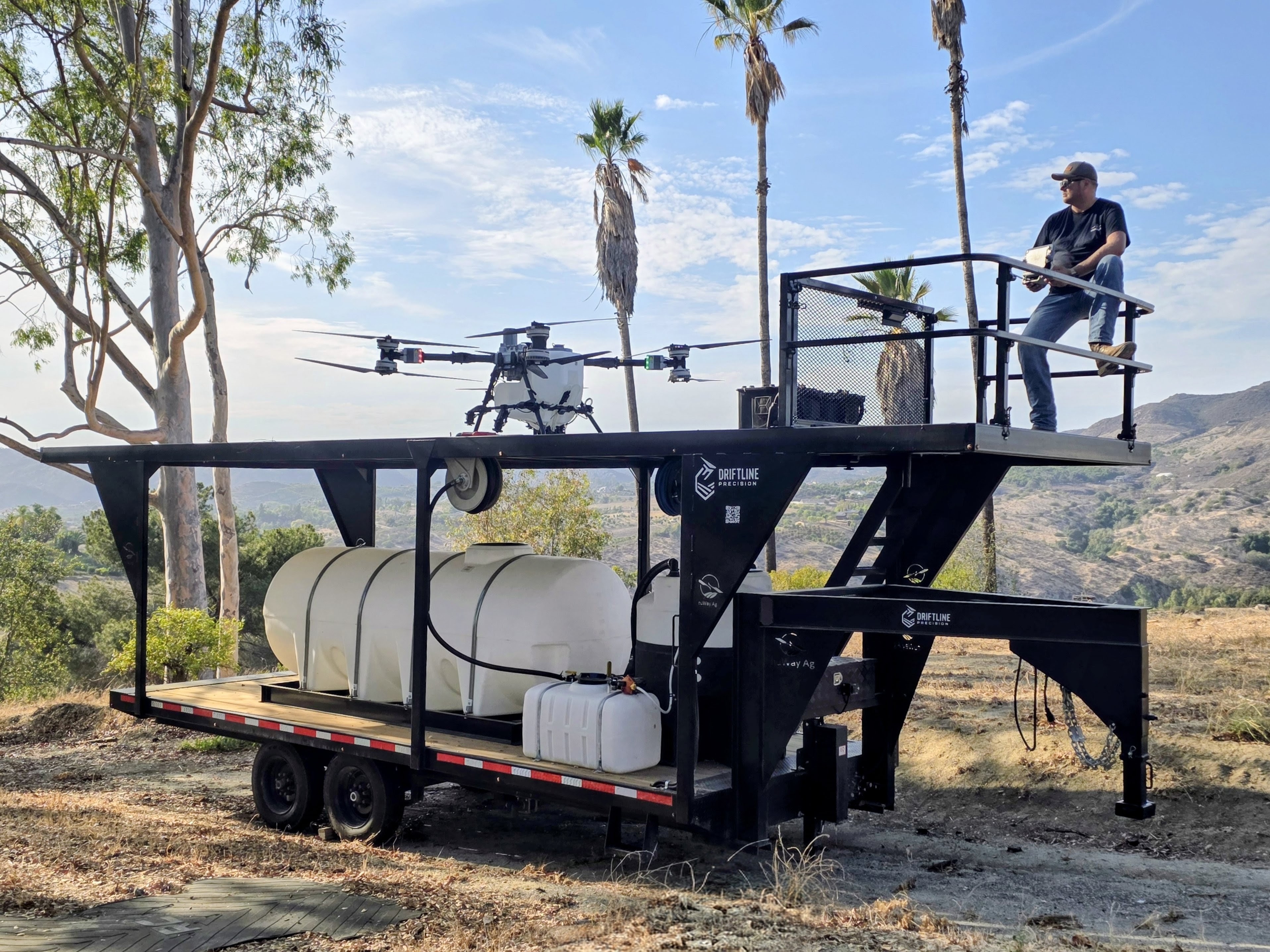
The company transports its operation on a trailer equipped with the supplies necessary for a day in the field, including water, chemical tanks and generators. The drone’s propellers and arms fold inward to make the large aircraft easier to transport.
At a job site, Justin can position the equipment near the field and program the drone to treat areas that may be inaccessible from the ground.
Although Justin handles much of the technical side of the operation, Crystal helps communicate what the technology can accomplish and how it may fit the needs of individual growers.
She said one of the company’s biggest challenges is simply educating potential customers. Agricultural drone spraying is widely used in some parts of the world but is still gaining acceptance in the United States.
“There are so many applications and so many uses,” Crystal said. “Every farm, every crop and every situation has a problem that can be solved with this technology.”
The couple does not present drones as the answer to every agricultural challenge. Helicopters and fixed-wing aircraft remain valuable for treating vast acreage quickly, while traditional ground equipment will continue to serve farms where it is practical and effective.
Driftline Precision is instead offering another option — one capable of serving large, open agricultural operations as well as Southern California’s smaller fields, steep hillsides and varied crops.
For Justin, the appeal remains much the same as it was when he first flew a drone over the Santa Margarita River: using technology to see land differently and solve problems that once required considerably more time and labor.
“It’s a lot of fun,” he said as one of the company’s large drones lifted into the air. “There’s a real market here, and we can help a lot of farmers.”