March has greeted us clobbering us with record heat. UGH! But if you kept your roses hydrated, you probably now have an abundance of fresh new foliage and maybe even beautiful blooms—with more to come.
Ever wonder how you can get better results from one year to the next? Gardening is a partnership between you and your plants: How about letting your garden (and your roses) “speak” to you? Take a daily walk around your garden and get to know all that lives there. For example, take careful note of what is typical of each rose variety in your garden. Is the foliage of one variety usually shinier than others? Maybe more purple when young, or greener? How about the number, size, and length of stems and buds? Do some varieties need more frequent watering than others? Do some varieties grow better in cool or warmer weather?
This awareness will help you notice earlier when something is going wrong. For example, you’ll be better able to recognize when a given variety’s foliage is starting to look dull (low water?) or has a white cast (mildew?) or orange spots on the underside of the leaves (rust?). You’ll notice insect damage sooner too, such as the yellow or bronze color and distorted or stunted growth caused by chilli thrips, the webs and “graininess” from spider mites, or the holes in petals nibbled by Hoplia beetles. They should be present soon with the warmer weather of late.
Have a plan for what to do when you notice the signs of stress, insect damage, or fungal disease. One approach that has become very popular over the past few decades is called “Integrated Pest Management” (IPM). It “integrates” mechanical, biological, and chemical controls to take an environmentally gentler approach for safe and successful gardening.
Mechanical Control
Your first line of defense in IPM is also the simplest and cheapest (YAY!). For rose gardeners, these include:
- Early spring pruning allows more ventilation through the center of the plant (reducing fungal infection).
- Stripping off diseased leaves regularly and picking dead leaves from the garden bed and disposing them in the green waste bin.
- Applying a 3” to 4” layer of composted mulch or other to the entire bed to reduce evaporation and keep the soil moisture and temperature more uniform (to avoid water stress and build robust root systems that strengthen the plant overall).
- Rinsing down foliage to wash away dust (and the fungal spores that adhere to it). This should be done in early morning before the sun is too “HOT”.
- Directing a strong spray of water to the undersides of foliage to blow away spider mites (usually lower branches), and aphids and thrips (usually ends of stems and buds). (Aphids are the first pest in spring, so check for them early and often: Females are born pregnant and reproduce quickly, so every time you spray them away, you prevent hundreds more!)
- Picking the gray/black Hoplia beetles (most notable on light colored blooms) between the petals light colored roses and drowning them in a cup of soapy water. (Keep score – it’s fun!)
- Watching for “lacy” leaves and manually squishing the tiny rose slugs on the undersides of the leaves.
Biological Control
Your next line of defense involves marshaling help from your friends in the garden. Birds and insects (such as lady bugs, green lace wings, praying mantises, minute pirate bugs, assassin bugs and fly larvae) all eat some garden pests:
- Attract more of them by growing a diverse range of annual plants. There are many companion plants that attract beneficial insects.
- Add a water feature such as a birdbath.
- Buy and release lady bugs and/or praying mantises.
- Examine branches you prune off for praying mantis egg cases and setting them aside in a protected spot in the garden where they can mature without being trampled or tossed out.
Chemical Control
The last line of defense in IPM allows the use of pesticides – that is, anything that kills insects (insecticides), mites (miticides), or powdery mildew and other fungi (“fungicides”). You must first identify and target just that pest. For personal safety and for minimal negative impact to pollinators and the environment, IPM advocates only the least toxic products – those labeled “Caution”. It’s always recommended that you spray early in the morning or late in the day when there is no bee activity.
I know gardeners who use pesticides as their first and only defense. This is costly, time-consuming, and can backfire by harming the good guys: the pollinators and other beneficials, along with other harmless insects. Not only does regular and exclusive use of powerful pesticides help your pest population develop genetic resistance to the chemicals, but it also kills off the other insects that would otherwise eat those pests! This is doubly bad because broad-spectrum insecticides don’t kill mites – so you can create an infestation of spider mites that will be delighted to have their insect predators eliminated! (For more on the problems associated with using only pesticides, see http://ipm.ucanr.edu/PMG/GARDEN/PLANTS/rose.html).
Gardeners who prefer not to spray often apply granular all-in-one products that combine fungicide, fertilizer, and a broad-spectrum pesticide. This is a double whammy. It kills ALL insects, including pollinators, and it kills off beneficial fungi in the roots and soil. In addition, you can’t use any parts of the rose for any edible product for fragrance, cooking, or tea.
Rose Garden Care This Month
Now let’s talk about how you can apply many of these techniques this month in your garden!
Roses have increased foliage by now and an inspection of each plant may have lots of non-bloom foliage growing in the middle of the plant. It would be wise to remove these by thumb pruning or cutting away to improve air circulation. These are usually small inconsequential growths.
We’re all aware that too little water can stress roses, but roses are also vulnerable to overwatering, and that might be a danger if you’re especially urgent in your irrigation. Pay close attention to drainage in your rose beds. While do like plenty of water, soggy conditions can literally drown the roots—that is, deprive them of the oxygen they need to stay alive. If you see pools of water standing in your rose beds for a few hours after irrigating, try to provide a temporary path for drainage using a hoe or shovel.
Like most of us, roses love food, preferably good quality food on a regular basis. Not all fertilizers include all the micro/macro nutrients needed, so read the label on the packaging. Alternating the major fertilizer with fish emulsion of “Better Than Fish” every 2 weeks will help provide some of the micronutrients. As I always say, organics are much better for your soil and for your garden and the environment. I’m told that sprinkling 1/2 cup of Epsom Salt (Magnesium Sulfate) around large size plants, 1/4 cup for smaller plants, once in Spring and once in Fall can assist in getting new basal breaks (new canes from the bud union). I’ve done this many times but I’m not sure it works! However, recently I’ve read that Epsom Salt helps plants assimilate other minerals (fertilizers) in the soil and assists in “greening” up vegetation.
For general health and aeration, the soil needs a supply of organic material such as humus incorporated into the depths. That isn’t easily accomplished in established gardens, by adding a 3” to 4” of a good composted mulch over the entire garden, leaving a 12” diameter circle open around base of each bush will go a long way to enriching your soil overall because over time earthworms help transport that mulch down into the soil where the microbiology is complex and multi-tiered. Adding a handful of worm castings now is a good idea for improving the soil biome.
A healthy garden soil system is teeming with beneficial microbes that inhibit, compete with, and consume disease-causing organisms. This creates a sustainable soil “immune system.” In fact, plants grown with organic fertilizers are themselves more resistant to pests and diseases. In addition, when you feed those beneficial organisms, they feed your roses. That’s because they are busy breaking down organic matter and releasing mineral nutrients slowly and reliably. I’ve recently learned that extra phosphate in the fertilizer that you use is most important in assisting in creating a soil environment that aids immensely in helping plants to be resistant to pests and diseases. Also helping plants to develop hardier root systems and larger blooms.
Many gardeners become discouraged when they first experiment with organic treatments while still using chemical fertilizers. It is difficult, in fact, almost impossible—to have it both ways. Chemical fertilizers negatively impact on the soil food web by poisoning entire portions of it. The fact is chemical fertilizers are salts! What gardener hasn’t seen what table salt does to a slug or snail? Salts absorb water and dehydrate the soil microbes which are the foundation of the soil nutrient system. Once you’ve used chemical fertilizers regularly you must keep adding more because the soil microbiology is weakened and unable to do its job of releasing naturally available nutrients to your plants.
Rain helps to leach accumulated salts from the soil if there is sufficient drainage. Organic fertilizers and amendments (such as manure, compost, or mulch) break down slowly, staying where you put them, and don’t contribute to groundwater pollution (as long as you prevent running off into drains). In addition, they improve the soil food web, so in the long run you end up using less product.
Chemical fertilizers are artificial growth stimulants and, in the long run, harm your soil and pollute local waterways because as dissolved salts they quickly leach through the soil (becoming unavailable to your plants) and enter the ground water. How about swearing off chemical fertilizers for the rest of the year and starting to use organics? Give it a year. See if your roses don’t reward you! Fish emulsion diluted in water is also a good amendment, applied either to the foliage or onto the soil around each bush.
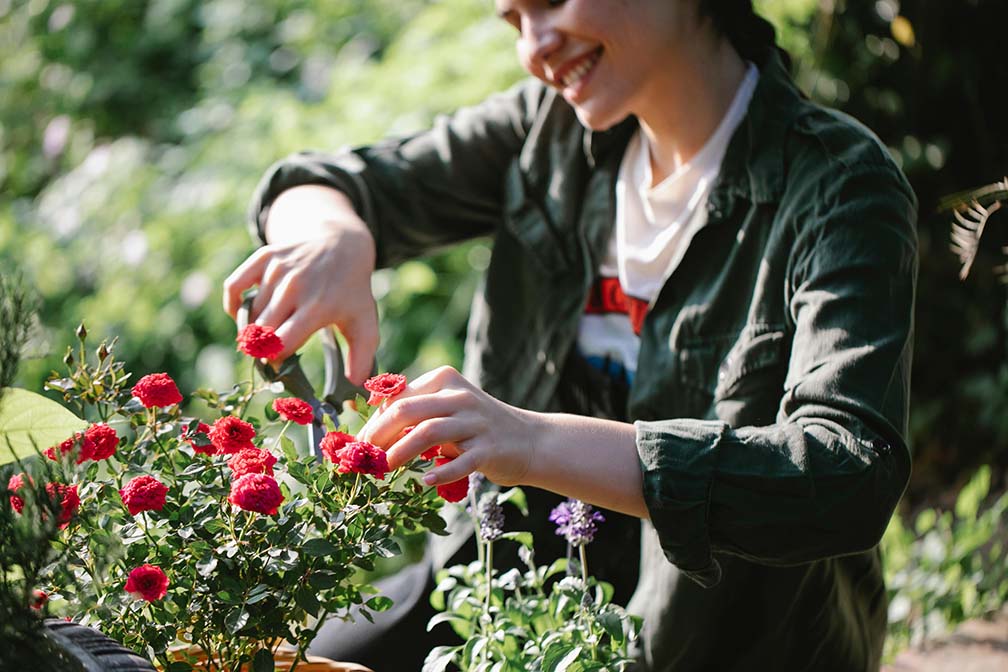
You may have had some blooms already. Prune off the spent blooms. Cut the cane back to an outward facing bud at a 3-5 leaflet leaf for new growth. Air circulation is important to help prevent fungi diseases. The small spurs growing inside the bush can easily be finger pruned to keep the center of the bush free of extraneous growth.
Giving the bush an early morning shower to rinse off the leaves may help to avoid powdery mildew. Do this early enough so that the leaves will dry prior to the hot sun. It is possible that with nighttime dew a disease called Botrytis can appear as discolored spots on the blooms, especially on blooms with 40 or more petals. Remove these as soon as the disease is noticed. Even with great observations and preventive methods, fungi may become a problem and chemical treatment may be needed to keep disease at bay. Make sure to deep water. An extended slow watering is more beneficial than a frequently short application.
San Diego Rose Society is planning a rose show May 5, another close to you is held at the Los Angeles County Arboretum and Botanical Garden in Arcadia, California on April 25/26 so please try to attend to see, smell and learn about different varieties and find a new one for your garden! for more information go to: https://www.sandiegorosesociety.com/.
For more ideas, visit TVRS’ Rose Haven Garden at 30592 Jedediah Smith Rd., Temecula, as well as our web site at TemeculaValleyRoseSociety.org/index.shtml. Spread the joy of roses!